At my place of business we use alot of MS Terminal Services 2003 coupled with a commercial linux distro that runs rDesktop called 2x. Alot of our ends users specifically needed to take pictures with their digital camera and upload them to the server(the camera is configured to display as a usb disk drive). This was working fairly well up until recently when all of a sudden the user would go to access the camera as a RDP redirected drive and it would wait and wait and wait about 30 seconds then show you the folder and it was the same for each click into a sub folder on the drive. We tried everything uninstall antivirus, different service packs, different client(including a custom linux distro I built years ago with thinstation.org), no luck.
So I worked on something else for a week, to be honest I thought: Wow, what a weird issue hope somebody else has seen it and written something up. I came back to it today and thought it had to be failing out somewhere on what I assumed to be a file type access so I ran filemon utility from Microsoft. To be honest never run this utility on a box that is in production it generates alot of crap I mean output. Sure enough within two minutes I figured out the issue, and why it came up just recently. The explorer process was trying to access a network share called \\tsclient\hotplug (this is what usb drives are redirected under from linux) and getting back a ”path not found” error. While I have seen the explorer bar read \\tsclient\C numbers of times on redirected drives I never gave it much thought. I thought it was a Microsoft cute way of integrating the RDP into the explorer. Well in a normal network this works fine the system puts a request out to DNS/hosts/WINS and fails out nearly instantly, and then some peice of code must then point the name to the server itself. Our systems were resolving tsclient to an actual IP via the DNS upstream provider we started using OPENDNS. OPENDNS has a couple of nice features our ISP doesn’t provide DNS STATS, DNS Blacklisting, Typo correction, and guided search so if a user types a incorrect web address it will try and correct or bring you to a search page with that as a search keyword. The way this works is for unresolvable names it returns the IP address of OPENDNS server and your webbrowser goes to their servers and they serve up a search page using the host header you requested. So on our terminal server when our users would click into the \\tsclient\hotplug , the system would resolve the name tsclient and it receive a IP to OPENDNS servers that would then need to failout, and then go about its normal rendering of the tsclient shares. The best solution I figured out was to create a DNS entry for “tsclient ” on our internal DNS servers and have it resolve to 127.0.0.1. This solved the speed issue instantly.
Hope this helps someone else!
Filed under: Uncategorized
As I have worked with Sharepoint project I tried to ensure one thing: that a user should be able to customize and update any image, text, etc from within the browser easily. Well, What isn’t available for editing in the browser pretty much nothing. But do you want a end user updating something in a master page. For example if you created a footer globally in a master page and applied it across all sites do you want a end user coming in and trying to edit the one page that can break the entire site? Answer add a web part to a master page specifically a dataview webpart like in http://whostheman.wordpress.com/2009/05/09/adding-customized-webparts-to-masterpage/ . By linking this to a list it will allow a end user to update using the Sharepoint list item. To begin create a custom list by going to Site Actions -> Create and choosing Custom List call it Footer. Once that is done create
a column called Body

Now create a new list item:

Now comes the interesting part open up Sharepoint Designer (the best free CMS designing tool I’ve found) and open your master page.
Find the very bottom of your page I recommend following the table tags for instance the ms-main table add the following after the last </TR> tag:
<tr><td><div class=”footer”>TEST</div></td></tr>

Now we can insert the data view web part click in the table row where the word test appears: Insert->Sharepoint Controls->Data View. This will open the data sources library pane to the right hand right of the screen. Right click the footer list to the right and select Show Data. Drag the Body row into the web part. It should look like this:

Now right click the left hand side where is says Body choose Delete->Delete Columns. This should should make your footer text the only column shown. Go into the code view windows and got the following line <xsl:value-of select=”@Body” disable-output-escaping=”yes” /></td> and delete the class and width tag above this line in the TD tag. Select the body area and right click and choose Format Item as->Rich Text. The last thing is to add a peice of code to ensure the webpart displays properly on subsites:
<WebPartPages:DataFormParameter ParameterKey=”WebURL” PropertyName=”ParameterValues” DefaultValue=”/” Name=”WebURL”></WebPartPages:DataFormParameter>
This needs to be added before each of the following:
</SelectParameters>
</DeleteParameters>
</UpdateParameters>
</InsertParameters>
and delete the word test we added in the beginning,
You should be able to save andhave something that looks like this, remember that it can be completely stylized with the footer CSS tag:

In case you have never seen this article for creating a list of members dataview of a Active Directory group I highly recommend it http://www.sharepointblogs.com/wsspectacular/archive/2008/01/10/how-to-display-an-ad-group-in-a-sharepoint-dataview.aspx. I found this very useful for creating staff directory under different departmental pages in our organization. You can perform it by creating a SQL view for each department, and displaying it as a data view. This also puts the requirement on those departments to update the IT dept in case of changes, normally departments notice something is wrong within the website before they ever open an Outlook Distribution/Security Group to check the members. Also in case your organization is lacking information this can be used as a driving factor to ensure accurate information within AD.

Filed under: Sharepoint
A person might ask, Why would I want to add a webpart to the master page? For me the question normally is, Why do I need to have a top nav, left nav, and breadcrumbs? Isn’t just two of the three just as good? I prefer removing the left nav this opens the space in the page a great deal and on simpler sites works nicely. Now I have room to add sponsored links or links/info that I want on every page to the right and whats the point of using Sharepoint if you don’t leverage the list model. During my recent project we needed to ensure that someone updating the sponsors and links could do it with very little knowledge of websites and thru the browser. So we decided on using two Sharepoint lists to control the content of two webparts embedded in the master page. One of them is a standard Announcements list and the other is a Picture Library with one additional site column added “Web Page”. Here is a diagram of how it lined up:

This is very simple for a top level site just insert a dataview webpart in sharepoint designer and link it to your Sharepoint List and your done, but once you go into a subsite using that master page you get the dreaded:
“Unable to display this Web Part. To troubleshoot the problem, open this Web page in a Windows SharePoint Services-compatible HTML editor such as Microsoft Office SharePoint Designer. If the problem persists, contact your Web server administrator.”
The answer is just to add this line four times per this excellent blog entry http://www.neilrichards.net/blog/?p=42 one for each parameter (Select, Update, Insert, Delete)
<WebPartPages:DataFormParameter ParameterKey=”WebURL” PropertyName=”ParameterValues” DefaultValue=”/” Name=”WebURL”>
What this does is tell the Sharepoint this list lives on the top level site. I find this handy in case there is a need to have announcements listed on every page.
SO your code goes from this :
<SelectParameters>
<WebPartPages:DataFormParameter ParameterKey=”ListID” PropertyName=”ParameterValues” DefaultValue=”71A31DD1-1941-4159-B389-DF7373E9150C” Name=”ListID”></WebPartPages:DataFormParameter>
</SelectParameters>
<UpdateParameters>
<WebPartPages:DataFormParameter ParameterKey=”ListID” PropertyName=”ParameterValues” DefaultValue=”71A31DD1-1941-4159-B389-DF7373E9150C” Name=”ListID”></WebPartPages:DataFormParameter>
</UpdateParameters>
<InsertParameters>
<WebPartPages:DataFormParameter ParameterKey=”ListID” PropertyName=”ParameterValues” DefaultValue=”71A31DD1-1941-4159-B389-DF7373E9150C” Name=”ListID”></WebPartPages:DataFormParameter>
</InsertParameters>
<DeleteParameters>
<WebPartPages:DataFormParameter ParameterKey=”ListID” PropertyName=”ParameterValues” DefaultValue=”71A31DD1-1941-4159-B389-DF7373E9150C” Name=”ListID”></WebPartPages:DataFormParameter>
</DeleteParameters>
To this:
<SelectParameters>
<WebPartPages:DataFormParameter ParameterKey=”ListID” PropertyName=”ParameterValues” DefaultValue=”71A31DD1-1941-4159-B389-DF7373E9150C” Name=”ListID”></WebPartPages:DataFormParameter>
<WebPartPages:DataFormParameter ParameterKey=”WebURL” PropertyName=”ParameterValues” DefaultValue=”/” Name=”WebURL”></WebPartPages:DataFormParameter>
</SelectParameters>
<UpdateParameters>
<WebPartPages:DataFormParameter ParameterKey=”ListID” PropertyName=”ParameterValues” DefaultValue=”71A31DD1-1941-4159-B389-DF7373E9150C” Name=”ListID”></WebPartPages:DataFormParameter>
<WebPartPages:DataFormParameter ParameterKey=”WebURL” PropertyName=”ParameterValues” DefaultValue=”/” Name=”WebURL”></WebPartPages:DataFormParameter>
</UpdateParameters>
<InsertParameters>
<WebPartPages:DataFormParameter ParameterKey=”ListID” PropertyName=”ParameterValues” DefaultValue=”71A31DD1-1941-4159-B389-DF7373E9150C” Name=”ListID”></WebPartPages:DataFormParameter>
<WebPartPages:DataFormParameter ParameterKey=”WebURL” PropertyName=”ParameterValues” DefaultValue=”/” Name=”WebURL”></WebPartPages:DataFormParameter>
</InsertParameters>
<DeleteParameters>
<WebPartPages:DataFormParameter ParameterKey=”ListID” PropertyName=”ParameterValues” DefaultValue=”71A31DD1-1941-4159-B389-DF7373E9150C” Name=”ListID”></WebPartPages:DataFormParameter>
<WebPartPages:DataFormParameter ParameterKey=”WebURL” PropertyName=”ParameterValues” DefaultValue=”/” Name=”WebURL”></WebPartPages:DataFormParameter>
</DeleteParameters>
One I hope this better highlights http://www.neilrichards.net/blog/?p=42 as a excellent resource.
Filed under: Sharepoint
I recently just finished a project to convert a marketing website design my organization is using into a fully functional sharepoint site. I think the number one rule I tried to hold myself to was “Don’t Touch the Master Page!”. When I started working with Sharepoint and I wanted to change the look and feel of a site I would just start editing default.master page in Designer. While this is a valid method I have learned much more effective ways without the likelyhood of breaking something.
1) Always begin with a OOTB masterpage that best meets the style you are going for (OK in WSS there is only one but you can download the Master Page pack from Microsoft) I like blueband.
2) Install the developer tools for the browser of your choice: IE, FireFox, and Safari have developer toolbars for this purpose and I personally love Google Chrome OOTB Inspect Element.
3) Create a Style Sheet in Browser or with Designer(I Prefer Designer) and add it to the website under the Site Settings -> Look and Feel -> Master Page -> Alternate CSS URL
While some people might opt for adding it as a csslink to the masterpage immediately this doesn’t offer the same flexibilty of changing to another CSS file in browser.
4) The CSS tag you should get to love is: display:none . In other words start hiding the stuff you dont need. Most likely you will not want to have the text Site Title in the upper left hand corner so just set it to display:none. Always begin with the deveopler toolbar and find where the tag value is coming from. I recommend Heather Solomon’s CSS reference to help, but be warned her CSS list doesn’t include all tags used in the MOSS Master Pages such as BlueBand.master(a personal favorite).
5) Change the Master Page only after you realize it can’t be changed with CSS alone, also be warned its alot easy to hide a object in CSS and bring it back in a pagelayout with a inline style, then to set it as hidden. The search bar can be the worst alot of time in the publishing site I remove it and add in a custom one also to keep the look and feel I create a custom search results page so te application.master is not seen.
6) Add your style sheets to the Master Page after the last CSSRegistraion
<SharePoint:CssRegistration name=”<% $SPUrl:~sitecollection/Style Library/~language/Core Styles/custom.css %>” runat=”server”/>
7) You made your website look great but did you ensure it still prints well? Created a basic CSS file that hides everything but the content. Diplay:none is your friend.
<link rel=”stylesheet” type=”text/css” href=”/style library/en-US/Core Styles/print.css” media=”print” />
Here is my Print.css I already have the leftnav hidden:
.authoringRegion, .topArea, .topNavContainer {
display:none;
}
.mainContainer{
vertical-align:top;
}
Default Web Page before Style Sheet:

Hide Left Nav, Reposition DIV tags float left and right, expand topnav button size,hide logo and site title text increase background image in toparea and set to new image

Filed under: Cisco
If you have never logged into a *nix box on your network or onto a core router (if you have one) and ping-ed a couple multicast addresses your missing some fun. Lets say I was trying to track a router down the was misconfigured to use RIPv2. Obviously the easiest way is to wait for the router to send its broadcast out and read it with a packet sniffer. But what if you don’t have a packet sniffer handy(wait everybody has at least wireshark) and your just logged into a *nix box or router/switch. Answer: Ping the multicast address ! If you ping the address 224.0.0.9(the multicast address for RIPv2), your off and running. You should receive the pings from the devices configured to listen on that address. Unfortunately this doesn’t work the same in windows the ping program only looks for one reply and stops looking after that versus the *nix and router/switch see all the replies and list them all.

responses from multicast ping
Here is a list of well know router protocols and their multicast addresses:
- 224.0.0.1 all hosts on a subnet
- 224.0.0.2 all routers on a subnet
- 224.0.0.4 Distance Vector Multicast Routing Protocols (DVMRP)
- 224.0.0.5 OSPF routers
- 224.0.0.6 OSPF designated routers
- 224.0.0.9 RIP Version 2 routers
- 224.0.0.10 EIGRP
- 224.0.0.13 Protocol independent Multicast (PIM)
Happy pinging!
I recently took the Microsoft 70-631 WSS Configuration exam and passed it. I have this bit of info for those attempting to pass the exam: know both deployment scenarios around using publishing ISA Server 2004/2006 and Network Load Balancing (Unicast versus Multicast) nearly half the questions were focused on this and not on Sharepoint.
Filed under: Sharepoint, Uncategorized | Tags: MOSS 2007, RSS, Sharepoint, Webpart, WSS 3.0
As part of my recent Sharepoint work I worked on finding a good Weather webpart the best that I could find was the following from http://blogs.msdn.com/ketaanhs/archive/2008/03/22/showing-weather-web-part-using-rss-weather-yahoo-com-in-sharepoint-2007.aspx
The RSS feed I used was:
And used the following XSL Spreadsheet:
<?xml version=”1.0″ encoding=”ISO-8859-1″?>
<xsl:stylesheet version=”1.0″
xmlns:xsl=”http://www.w3.org/1999/XSL/Transform” xmlns:yweather=”http://xml.weather.yahoo.com/ns/rss/1.0” xmlns:geo=”http://www.w3.org/2003/01/geo/wgs84_pos#”>
<xsl:output method=”html” indent=”yes”/><xsl:template match=”/”>
<xsl:variable name=”scale”>
<xsl:value-of select=”rss/channel/yweather:units/@temperature”/>
</xsl:variable><table width=”100%” border=”0″ cellspacing=”0″ cellpadding=”3″ class=”Normal”>
<tr bgcolor=”#075C70″>
<td colspan=”2″><strong><font color=”white”>Weather Report – <xsl:value-of select=”rss/channel/item/title”/></font></strong></td>
</tr>
<tr>
<td><strong><font size=”4″><xsl:value-of select=”rss/channel/item/yweather:condition/@temp”/><xsl:text>°</xsl:text><xsl:copy-of select=”$scale” /></font></strong><br/>
High <xsl:value-of select=”rss/channel/item/yweather:forecast/@high”/> <xsl:text>°</xsl:text><xsl:copy-of select=”$scale” /> <br/>
Low <xsl:value-of select=”rss/channel/item/yweather:forecast/@low”/> <xsl:text>°</xsl:text><xsl:copy-of select=”$scale” /> </td>
<td>
<xsl:text disable-output-escaping=”yes”><img src=”http://us.i1.yimg.com/us.yimg.com/i/us/we/52/</xsl:text>
<xsl:value-of select=”rss/channel/item/yweather:condition/@code”/>
<xsl:text disable-output-escaping=”yes”>.gif”/></xsl:text>
<br/>
<xsl:value-of select=”rss/channel/item/yweather:condition/@text”/></td>
</tr>
<tr bgcolor=”#075C70″>
<td colspan=”2″><strong><font color=”white”>2 Day Forecast</font></strong></td>
</tr>
<tr>
<td colspan=”2″><table width=”100%” border=”0″ cellspacing=”0″ cellpadding=”3″ class=”Normal”>
<xsl:for-each select=”(rss/channel/item/yweather:forecast)[position() < 3]“>
<tr>
<td><xsl:value-of select=”@day”/></td>
<td>
<xsl:text disable-output-escaping=”yes”><img src=”http://us.i1.yimg.com/us.yimg.com/i/us/we/52/</xsl:text>
<xsl:value-of select=”@code”/>
<xsl:text disable-output-escaping=”yes”>.gif”/></xsl:text>
</td>
<td><xsl:value-of select=”@text”/><br/>High: <xsl:value-of select=”@high”/>
<xsl:text>°</xsl:text><xsl:copy-of select=”$scale” />
Low: <xsl:value-of select=”@low”/><xsl:text>°</xsl:text><xsl:copy-of select=”$scale” />
</td>
</tr>
</xsl:for-each>
</table></td>
</tr>
</table></xsl:template>
</xsl:stylesheet>
And you end up with this:
Both WSS and MOSS versions of the webpart are uploaded to http://10235.freesharepoint2007.com/Downloads/Forms/AllItems.aspx
Filed under: Uncategorized | Tags: MOSS 2007, Sharepoint, SQL, Webpart, What's Up, WSS 3.0
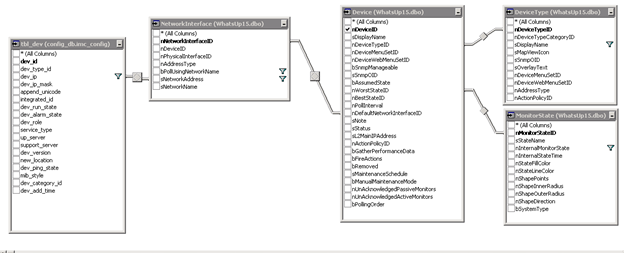
As part of a implementation at work I have been trying to integrate applications (mainly SQL backend) applications into Windows Sharepoint Services 3.0 and MOSS 2007. While What’s Up uses SQL it comes with either MSDE 2000 or SQL 2005 Express in order to access it via the network you will need t enable TCP/IP access. I used Sharepoint Designer 2007 and created a data view on a test page and then exported the web part and imported into our layout based main page(a good way to get a custom web part into a ghosted/attached layout page). The problem was finding the correct SQL query to generate a table of down devices from Whats Up Gold here is the query I used at first which just gives the device and how long it has been down which is just the default query from What’sUp Dynamic Groups.
SELECT DISTINCT Device.nDeviceID FROM Device JOIN MonitorState ON Device.nWorstStateID = MonitorState.nMonitorStateID WHERE Device.bRemoved = 0 AND MonitorState.nInternalMonitorState = 1
Here is the webpart it displays the time down is different colors yellow for currently down, orange for 2 mins, and red for 5 mins or more to customize to your enviroment replace whatsupserver with your server name and username and password with yours:
<webParts>
<webPart xmlns=”http://schemas.microsoft.com/WebPart/v3“>
<metaData>
<type name=”Microsoft.SharePoint.WebPartPages.DataFormWebPart, Microsoft.SharePoint,Version=12.0.0.0, Culture=neutral, PublicKeyToken=71e9bce111e9429c” />
<importErrorMessage>Cannot import this Web Part.</importErrorMessage>
</metaData>
<data>
<properties>
<property name=”PageSize” type=”int”>-1</property>
<property name=”HelpMode” type=”helpmode”>Modeless</property>
<property name=”Height” type=”string” />
<property name=”SampleData” type=”string” null=”true” />
<property name=”AllowConnect” type=”bool”>True</property>
<property name=”CatalogIconImageUrl” type=”string” />
<property name=”XslLink” type=”string” null=”true” />
<property name=”AllowClose” type=”bool”>True</property>
<property name=”Hidden” type=”bool”>False</property>
<property name=”MissingAssembly” type=”string”>Cannot import this Web Part.</property>
<property name=”TitleIconImageUrl” type=”string” />
<property name=”ChromeState” type=”chromestate”>Normal</property>
<property name=”FireInitialRow” type=”bool”>True</property>
<property name=”Description” type=”string” />
<property name=”AllowMinimize” type=”bool”>True</property>
<property name=”Xsl” type=”string”>
<xsl:stylesheet xmlns:xs=”http://www.w3.org/2001/XMLSchema”xmlns:msdata=”urn:schemas-microsoft-com:xml-msdata” version=”1.0″ exclude-result-prefixes=”xsl
msxsl ddwrt” xmlns:ddwrt=”http://schemas.microsoft.com/WebParts/v2/DataView/runtime”
xmlns:asp=”http://schemas.microsoft.com/ASPNET/20”
xmlns:__designer=”http://schemas.microsoft.com/WebParts/v2/DataView/designer”
xmlns:xsl=”http://www.w3.org/1999/XSL/Transform” xmlns:msxsl=”urn:schemas-microsoft-com:xslt”
xmlns:SharePoint=”Microsoft.SharePoint.WebControls” xmlns:ddwrt2=”urn:frontpage:internal”>
<xsl:output method=”html” indent=”no”/>
<xsl:decimal-format NaN=”"/>
<xsl:param name=”dvt_apos”>’</xsl:param>
<xsl:variable name=”dvt_1_automode”>0</xsl:variable>
<xsl:template match=”/” xmlns:xs=”http://www.w3.org/2001/XMLSchema”xmlns:msdata=”urn:schemas-microsoft-com:xml-msdata”
xmlns:asp=”http://schemas.microsoft.com/ASPNET/20”
xmlns:__designer=”http://schemas.microsoft.com/WebParts/v2/DataView/designer”
xmlns:SharePoint=”Microsoft.SharePoint.WebControls”>
<xsl:call-template name=”dvt_1″/>
</xsl:template>
<xsl:template name=”dvt_1″>
<xsl:variable name=”dvt_StyleName”>RepForm1</xsl:variable>
<xsl:variable name=”Rows” select=”/dsQueryResponse/NewDataSet/Row” />
<xsl:variable name=”dvt_RowCount” select=”count($Rows)” />
<xsl:variable name=”IsEmpty” select=”$dvt_RowCount = 0″ />
<table border=”0″ width=”100%”>
<xsl:call-template name=”dvt_1.body”>
<xsl:with-param name=”Rows” select=”$Rows” />
</xsl:call-template>
</table>
</xsl:template>
<xsl:template name=”dvt_1.body”>
<xsl:param name=”Rows” />
<xsl:for-each select=”$Rows”>
<xsl:call-template name=”dvt_1.rowview”/></xsl:for-each>
</xsl:template>
<xsl:template name=”dvt_1.rowview”>
<tr>
<td width=”100%” colspan=”2″ class=”ms-vb”>
</td>
</tr>
<tr>
<td width=”100%” colspan=”2″ class=”ms-vb”>
<ahref=”http://whatsupserver/NmConsole/Workspace/DeviceStatus/DeviceStatus.asp?nDeviceID={@nDeviceID
}”><xsl:value-of select=”@sDisplayName” /></a>
<xsl:textxmlns:ddwrt=”http://schemas.microsoft.com/WebParts/v2/DataView/runtime”
ddwrt:nbsp-preserve=”yes” disable-output-escaping=”yes”>&nbsp;
</xsl:text>- <span>
<xsl:attribute name=”style”>
<xsl:if test=”normalize-space(@sStateName) =‘Down’”>color: #FFFF00;</xsl:if>
<xsl:if test=”normalize-space(@sStateName) = ‘Down atleast 2 min’”>color: #FF9900;</xsl:if>
<xsl:if test=”normalize-space(@sStateName) = ‘Down atleast 5 min’ or normalize-space(@sStateName) = ‘Down at least 20 min’”>color: #FF0000;
font-size: inherit;</xsl:if>
</xsl:attribute>
<xsl:value-of select=”@sStateName”disable-output-escaping=”yes” />
</span><br /></td>
</tr>
<xsl:if test=”$dvt_1_automode = ‘1′” ddwrt:cf_ignore=”1″>
<tr>
<td width=”100%” colspan=”2″ class=”ms-vb”>
<span ddwrt:amkeyfield=”nDeviceID,nMonitorStateID”ddwrt:amkeyvalue=”concat(ddwrt:EscapeDelims(string(@nDeviceID)),’,',ddwrt:EscapeDelims(string(@n
MonitorStateID)))” ddwrt:ammode=”view” />
</td>
</tr>
</xsl:if>
</xsl:template>
</xsl:stylesheet> </property>
<property name=”ListName” type=”string” null=”true” />
<property name=”ChromeType” type=”chrometype”>Default</property>
<property name=”AllowEdit” type=”bool”>True</property>
<property name=”ShowWithSampleData” type=”bool”>False</property>
<property name=”Direction” type=”direction”>NotSet</property>
<property name=”DataFields”type=”string”>@nDeviceID,nDeviceID;@sDisplayName,sDisplayName;@nMonitorStateID,nMonitorStateID;@
sStateName,sStateName;@nInternalMonitorState,nInternalMonitorState;@nInternalStateTime,nInternal
StateTime;@nStateFillColor,nStateFillColor;@nStateLineColor,nStateLineColor;@nShapePoints,nShape
Points;@nShapeInnerRadius,nShapeInnerRadius;@nShapeOuterRadius,nShapeOuterRadius;@nShapeDirectio
n,nShapeDirection;@bSystemType,bSystemType;</property>
<property name=”ViewContentTypeId” type=”string” />
<property name=”Width” type=”string” />
<property name=”CacheXslTimeOut” type=”int”>86400</property>
<property name=”TitleUrl” type=”string” />
<property name=”DataSourceID” type=”string” />
<property name=”HelpUrl” type=”string” />
<property name=”CacheXslStorage” type=”bool”>True</property>
<property name=”DataSourcesString” type=”string”><%@ Register TagPrefix=”sharepoint”Namespace=”Microsoft.SharePoint.WebControls” Assembly=”Microsoft.SharePoint, Version=12.0.0.0,
Culture=neutral, PublicKeyToken=71e9bce111e9429c” %><sharepoint:SPSqlDataSource
runat=”server” AllowIntegratedSecurity=”False” ConnectionString=”Data
Source=whatsupserver\whatsup;User ID=username;Password=password;Initial Catalog=WhatsUp;”
ProviderName=”System.Data.SqlClient” SelectCommand=”SELECT DISTINCT Device.nDeviceID,
Device.sDisplayName, MonitorState.* FROM Device INNER JOIN
MonitorState ON Device.nWorstStateID = MonitorState.nMonitorStateID WHERE (Device.bRemoved
= 0) AND (MonitorState.nInternalMonitorState = 1)”
ID=”WhatsUp_x0020_Server_x0020_Down_x0020_Devices1″></sharepoint:SPSqlDataSource>
</property>
<property name=”ExportMode” type=”exportmode”>All</property>
<property name=”AllowZoneChange” type=”bool”>True</property>
<property name=”Default” type=”string” />
<property name=”UseSQLDataSourcePaging” type=”bool”>True</property>
<property name=”ParameterBindings” type=”string”>
<ParameterBinding Name=”dvt_apos”Location=”Postback;Connection”/>
<ParameterBinding Name=”UserID”Location=”CAMLVariable” DefaultValue=”CurrentUserName”/>
<ParameterBinding Name=”Today”Location=”CAMLVariable” DefaultValue=”CurrentDate”/>
</property>
<property name=”DisplayName” type=”string” />
<property name=”NoDefaultStyle” type=”string”>TRUE</property>
<property name=”Title” type=”string”>WhatsUp Server Down Devices</property>
<property name=”AllowHide” type=”bool”>True</property>
<property name=”ViewFlag” type=”string”>0</property>
</properties>
</data>
</webPart>
</webParts>
And you end up with something that looks like this:
I hope this helps someone besides myself.